|
|
|
|

|
Content
|
|
2. Success story: EXCELLERAT Enables Exascale Airfoil Simulations for More Efficient and Sustainable Aviation
|
|
3. Podcast Episode: Training the Engineers of the Exascale Era
|
|
|
|
|
|
1. Welcome
|
Welcome to the 35th issue of the EXCELLERAT newsletter – and to another important milestone as we enter the final months of the EXCELLERAT P2 project.
|
In recent weeks, we have continued to highlight the impact of our work through a new success story on exascale-ready airfoil simulations, demonstrating how advances in HPC can contribute to more efficient and sustainable aviation. Our latest podcast episode also looks beyond individual applications and focuses on an equally important topic for the future of HPC: developing the skills and training structures needed for the exascale era.
|
As we approach the final stretch of the project, these activities reflect two central aspects of EXCELLERAT P2: advancing engineering applications through high-performance computing and strengthening the expertise and collaboration needed to make these technologies accessible and effective.
|
|
In this issue, we invite you to explore the latest success story, listen to our new podcast episode, and discover upcoming opportunities to connect with the EXCELLERAT community.
|
Best regards,
Bastian Koller
|
EXCELLERAT P2 Project Coordinator
|
|
|
|
2. Success story: EXCELLERAT Enables Exascale Airfoil Simulations for More Efficient and Sustainable Aviation
|
|
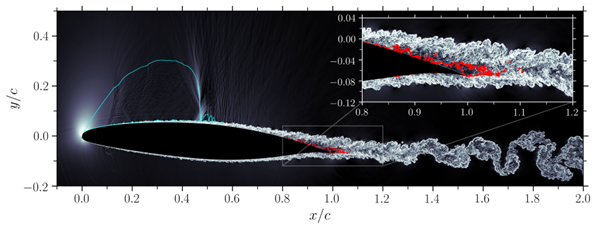
How can high-fidelity simulations help make aircraft more efficient while preparing engineering applications for exascale computing? A new EXCELLERAT P2 success story presents work by CINECA and Sapienza University of Rome using STREAmS, a high-order solver for compressible turbulent flows.
|
Within EXCELLERAT, STREAmS was advanced towards exascale readiness and portability across CPU and GPU architectures. More than 500 test runs on 10 HPC systems demonstrated scalable performance across NVIDIA, AMD, and Intel accelerators, with the largest case exceeding one trillion grid points. The team also investigated active flow-control strategies for airfoil optimisation at higher Reynolds numbers, showing potential for improved aerodynamic efficiency and energy savings.
|
The work demonstrates how exascale-ready simulation workflows can support future developments in sustainable aviation and other engineering applications.
|
|
3. Podcast Episode 16: Training the Engineers of the Exascale Era
|
The latest episode of the HPC Podcast powered by EXCELLERAT looks at a key question for the future of European HPC: how can we ensure that engineers and researchers have the skills needed for the exascale era?
|
Maria-Ribera Sancho from the Barcelona Supercomputing Center joins the podcast to discuss EVITA, the EuroHPC Virtual Training Academy. She explains how the initiative is developing a European Competence and Qualification Framework (CQF) and bringing together National Competence Centres, Centres of Excellence, universities, and training providers.
|
The episode explores how coordinated, high-quality training can contribute to a sustainable skills pipeline for HPC, AI, and emerging technologies – and help prepare the next generation of the European HPC workforce.
|
|
|
|
4. Further News & Events
|
|
|
EXCELLERAT Webinar – User Journey: Industrial HPC Access with SCALES, 30 September 2026: The second webinar in the EXCELLERAT User Journey series will feature Marvin Hubl from SSC, presenting the outcomes of SSC's collaboration with Qarnot to support industrial users through SCALES. The session will focus on industrial CAE and simulation applications and opportunities for collaboration. More information and registration
|
Training: Advanced CFD and Turbulence Modelling targeting HPC 20–22 October 2026 | Barcelona Supercomputing Center, Spain: This three-day training course explores advanced Computational Fluid Dynamics (CFD), turbulence modelling, and multiphysics simulations on HPC systems. Participants will gain practical experience with conjugate heat transfer, Large Eddy Simulation (LES), turbomachinery applications, GPU programming, and performance optimisation through lectures and hands-on tutorials led by experts from BSC, UKRI-STFC, and EDF.
|
Registration deadline: 1 October 2026 | More information and registration
|
|
Join the EXCELLERAT Community – Free of Charge: As an Interest Group Member, you will receive expert support, early access to innovations, and opportunities to showcase your work through the EXCELLERAT platform and events. Register now
|
|

|

|
|
Funded by the European Union. This work has received funding from the European High Performance Computing Joint Undertaking (JU) and Germany, Italy, Slovenia, Spain, Sweden, and France under grant agreement No 101092621.
|
High-Performance Computing Center Stuttgart (HLRS) | Nobelstrasse 19
|
|
70569 Stuttgart | Germany
|
|
|
|
|


