Success Story: Accelerating Steam Turbine Simulations with SPUMA on hybrid HPC clusters
success story # highlights:
- Keywords:
- Steam turbines
- Turbomachinery
- Energy
- CFD
- OpenFOAM
- SPUMA
- GPU computing
- Leonardo
- Open-source software
- Simulation-driven design
- Industry sector: Energy, Manufacturing & engineering
- Key code used: OpenFOAM, SPUMA
- Topic or Technologies: Simulation, Simulation Workflow, HPC Co-design
Benefits:
- 3–4× faster per iteration on one GPU than on 48–192 CPU cores
- Steam turbine CFD on open-source software, without licence costs
- Design variants assessed in 2 hours instead of 6 hours
- Up to 94 % less energy per simulation on GPUs
Organisation involved:
De Pretto Industrie is an Italian company specialising in steam turbines and energy systems. In this success story, it acted as the industrial end user, providing industrial use cases, and validation of the developed CFD workflow.
Cineca, the major Italian HPC centre, provided HPC expertise and software development support, implementing and validating advanced OpenFOAM © [1]/SPUMA functionalities for steam turbine simulations and enabling their execution on the GPUs of Leonardo using the SPUMA framework.
EXCELLERAT Products & Services:
The activities leading to this result were supported by several EXCELLERAT services available through the Service Portal:
Use-case onboarding service: enabled the submission of the proposal by the applicants and supported the assessment and onboarding of the industrial use case within the EXCELLERAT ecosystem.
SPUMA, Cineca’s open-source GPU-enabled extension of OpenFOAM: provided the technological foundation for the porting and optimisation of CFD workflows on modern HPC architectures.
[1] This offering is not approved or endorsed by OpenCFD Limited, producer and distributor of the OpenFOAM software via www.openfoam.com, and owner of the OPENFOAM® and OpenCFD® trade marks.
technical / scientific challenge:
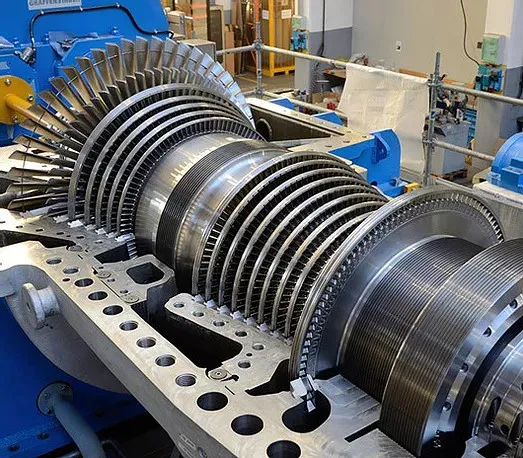
De Pretto Industrie needed an accurate and cost-effective CFD workflow for complex steam turbine stages, characterised by compressible high-speed flows, stator-rotor interactions, turbulence, and steam thermophysical effects.
Without the developments enabled by EXCELLERAT, De Pretto Industrie would have to rely on commercial CFD software or partially adapted open-source solutions, with significant manual customisation, higher licensing costs, longer development cycles, and little flexibility to use GPUs: on CPUs, one simulation of a stage took 5 to 8 hours on two compute nodes of Galileo 100.
Solution:
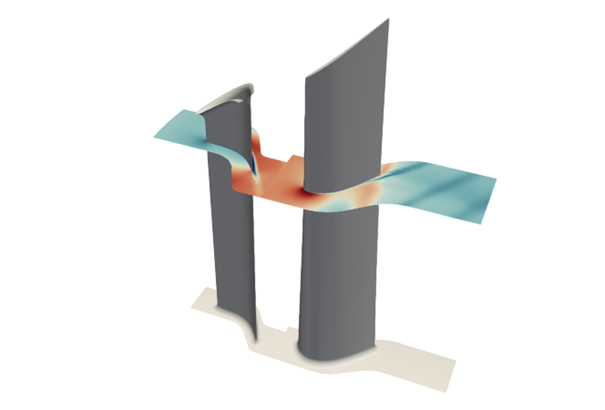
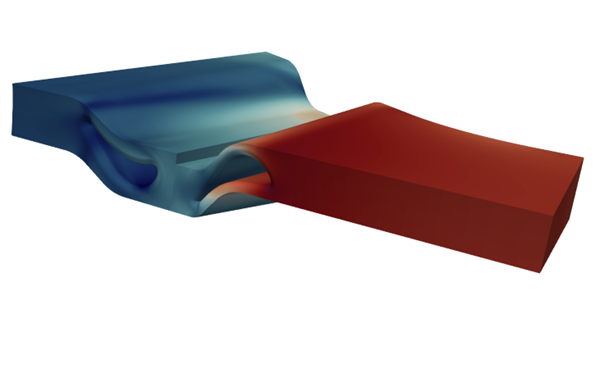
The challenge was addressed through a close collaboration between De Pretto Industrie and Cineca to enhance the open-source CFD platform OpenFOAM with advanced turbomachinery capabilities. Functionalities from the OpenFOAM community and new developments were integrated, including mixing-plane interfaces for stator-rotor coupling, partially overlapping interfaces for the frozen-rotor approximation, steam thermodynamic property modelling and dedicated boundary conditions. They were ported to GPUs in SPUMA, Cineca’s open-source GPU-accelerated fork of OpenFOAM, and validated on representative industrial turbine stages against earlier simulations and measurements on Leonardo: one A100 GPU ran each iteration 3 to 4 times faster than 48 to 192 CPU cores.
impact:
For De Pretto Industrie, turbine simulations now run on open-source software and GPUs. A design variant that took 6 hours to assess now takes 2 hours, so engineers can explore more blade and stage options before manufacturing and keep the simulation know-how in-house, without the licence costs of commercial software.
For the HPC and software community, the work shows that industrial turbomachinery cases run efficiently on GPUs: one A100 GPU did the work of up to 192 CPU cores. In other tests, SPUMA cut energy use by up to 82% compared with CPUs, for the turbine case is even higher (> 90%). The turbine features are now part of SPUMA and available to all its users in research and industry.
The cooperation has also built a lasting partnership between Cineca and De Pretto Industrie, with the next step already defined: the last turbine stages, where the steam becomes wet. Other manufacturers of turbines, compressors or pumps can follow the same path through EXCELLERAT’s use-case onboarding service.
Potential EXCELLERAT Services:
- HPC consultancy for turbomachinery engineering, including CFD workflow optimisation, scalability analysis, and simulation-driven design for steam turbine applications.
- GPU porting of industrial OpenFOAM cases: moving an existing OpenFOAM workflow to SPUMA on GPUs, with an assessment of speed and energy use.
unique value of each service:
- HPC consultancy for turbomachinery: experts who have already brought an industrial steam turbine case to GPUs, from model set-up to performance analysis on Leonardo.
- Engineering software development and co-design: new physics and GPU porting built into open-source software, so the customer owns its workflow, without licence fees.
- GPU porting of industrial OpenFOAM cases: faster, lower-energy runs of existing OpenFOAM cases on GPU systems such as Leonardo.