Success Story: Enhancing High-Lift Wing Performance through GPU-accelerated Simulations and Active Flow Control

success story # highlights:

  • Keywords:
    • Active flow control
    • Bayesian optimisation
    • Deep reinforcement learning
    • GPU-accelerated simulation synthetic jets
    • Aircraft aerodynamics
    • Take off and landing
    • MareNostrum 5
  • Industry sector: Aeronautics; potentially in vehicle aerodynamics and wind turbine blades
  • Key code used: SOD2D   

Benefits:

  • +10.9% lift-to-drag efficiency and −9.7% drag based on reference high-ligh airfoil. 30P30N case.
  • Efficient optimisation: coarse-grid training followed by fine-grid LES verification reduces the cost of optimum flow actuator parameters.
  • Integrated open-sourceCFD–ML capability: parallel GPU- accelerated simulation environments enable the exploration of closed-loop active flow control.
  • Clear future research priorities: improved DRL reward design, surrogate models, transfer learning and greater parallelism to reduce training time.
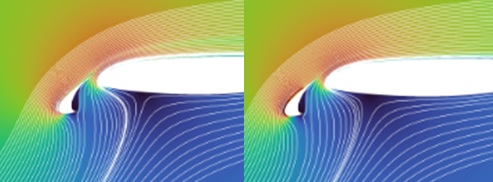
Figure 1: Time-averaged flow streamlines for the baseline configuration (left) and the Bayesian-optimised active flow control (AFC) configuration (right). Suction applied on the slat reduces the boundary-layer thickness and nearly eliminates the downstream slat wake, contributing significantly to the overall drag reduction.

Organisation involved:

The study was conducted by researchers from Universitat Politècnica de Catalunya (UPC), Spain´s national supercomputer center Barcelona Supercomputing Center (BSC-CNS), Delft University of Technology (TU Delft), and the University of Michigan. BSC contributed its GPU-accelerated SOD2D  high-order computational fluid dynamics (CFD) solver and access to the EuroHPC supercomputer MareNostrum 5  for large-scale simulations and machine-learning training.

codes involved:

SOD2D is spectral element code and one of the application software of Excellerat.

The ML workflow uses two open-source libraries: TF-Agents for reinforcement learning and SmartSim for coupling simulations with ML training on HPC systems.

technical / scientific challenge:

High-lift wing elements, such as slats and flaps, play a crucial role in aircraft aerodynamics during take-off and landing, enabling sufficient lift generation at low flight speeds. Their aerodynamic performance influences important operational characteristics, including runway length, climb rate and fuel efficiency. However, at high angles of attack, complex flow separation and interactions between these elements can significantly reduce aerodynamic efficiency. Active flow control (AFC) using synthetic jets offers a promising approach to mitigating flow separation and improving aerodynamic performance.

Identifying effective control strategies remains challenging due to the nonlinear aerodynamic response and strong interactions between the flow structures around different airfoil elements. Furthermore, evaluating these strategies requires computationally expensive high-fidelity simulations. Coupling GPU-accelerated computational fluid dynamics (CFD) with advanced optimisation and machine-learning algorithms introduces additional challenges in computational efficiency and data exchange.

Solution:

The team investigated active flow control on a standard three-element high-lift airfoil (30P30N) using high-fidelity wall-resolved large-eddy simulations (LES). The simulations were performed with SOD2D, a GPU-accelerated, open-source CFD solver developed at the Barcelona Supercomputing Center (BSC). Three synthetic jets, positioned on the slat, main element and flap, were used to influence the flow through controlled blowing and suction.

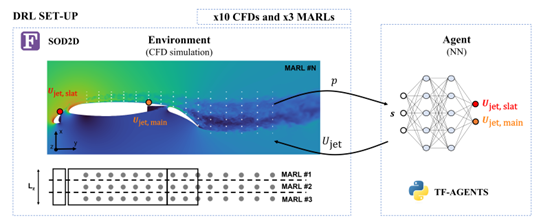
Two optimisation strategies were investigated. Bayesian optimisation (BO) explored fixed jet velocities, identifying an effective control configuration after only 19 simulations on a coarse mesh. The resulting configuration was subsequently evaluated on a finer mesh containing 81 million points. In parallel, deep reinforcement learning (DRL) was investigated as a closed-loop control approach, in which an agent dynamically adjusted the jet velocities based on pressure measurements. Using the SmartSim framework, 10 concurrent CFD simulations were coupled with the learning algorithm on 120 NVIDIA H100 GPUs of the EuroHPC supercomputer MareNostrum 5.

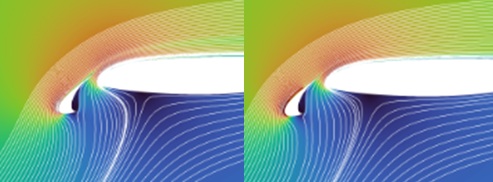
Fig. 2 : Time-averaged flow streamlines for the baseline configuration (left) and the Bayesian-optimised active flow control (AFC) configuration (right). Suction applied on the slat reduces the boundary-layer thickness and nearly eliminates the downstream slat wake, contributing significantly to the overall drag reduction.

impact:

The study demonstrates the potential of combining high-fidelity CFD simulations with advanced optimisation techniques to enhance the aerodynamic performance of high-lift configurations. For the 30P30N reference airfoil, Bayesian optimisation identified an effective synthetic-jet configuration that increased aerodynamic efficiency (lift-to-drag ratio) by 10.9% and reduced drag by 9.7%, while maintaining lift. These encouraging results highlight the opportunities offered by active flow control for developing more efficient high-lift systems, with potential benefits for aircraft performance during take-off and landing. The methodology also provides a promising basis for future investigations involving more realistic three-dimensional wing configurations.

An important achievement is the efficiency of the optimisation process, which identified the improved control configuration using only 19 CFD evaluations on a coarse mesh. In parallel, the development and successful implementation of a coupled CFD–DRL workflow represents a significant methodological step towards adaptive, sensor-based flow control. Although the current DRL approach did not achieve improvements in aerodynamic efficiency, the framework demonstrates the feasibility of integrating GPU-accelerated high-fidelity simulations with reinforcement-learning algorithms, establishing a foundation for further development of intelligent flow-control strategies.

The work also illustrates the capabilities of European HPC infrastructure for computationally demanding optimisation and machine-learning workflows. The reinforcement-learning training involved approximately 48,000 GPU-hours on 120 NVIDIA H100 GPUs of MareNostrum 5, demonstrating the integration of large-scale GPU-accelerated simulations with ML-based control methods. Together, these developments provide a foundation for further research into more efficient high-lift systems and advanced aerodynamic flow-control strategies.

Fig. 3: Ten GPU-accelerated SOD2D simulations of the high-lift airfoil (left) run concurrently, providing pressure measurements to a neural-network agent (right). The agent uses these measurements to dynamically adjust the synthetic-jet velocities. © UPC / BSC.

Potential EXCELLERAT Services:

The work is relevant to EXCELLERAT services in GPU-accelerated CFD, high-order turbulence-resolving simulations, workflow coupling and optimisation. Potential support includes configuring LES for challenging aerodynamic applications, integrating CFD with Bayesian optimisation or reinforcement learning, and assessing parallel execution strategies for computationally intensive training campaigns.

  1. Aerodynamic optimisation using high-fidelity GPU-accelerated CFD: Support for evaluating and optimising active flow control strategies and aerodynamic configurations, combining high-fidelity simulations with efficient optimisation techniques such as Bayesian optimisation.
  2. Integration of CFD and ML workflows on HPC systems: Support for coupling GPU-accelerated CFD solvers with machine-learning and reinforcement-learning frameworks, including workflow implementation, parallel execution and efficient utilisation of HPC resources.
  3. Technical support and training for SOD2D: Assistance with installation, simulation set-up, execution and performance optimisation of the SOD2D solver on GPU-based HPC systems.

unique value of each service:

These services combine expertise in advanced numerical simulation, GPU- accelerated HPC execution and data-driven optimisation. The main value is the ability to evaluate control strategies with physics-resolving simulations while using computational resources selectively: lower-cost simulations for exploration, higher-resolution simulations for verification, and concurrent GPU runs for ML training. The demonstrated results and limitations also help users select an appropriate optimiation approach for their problem.

  1. Efficient optimisation with high-fidelity validation: Combining lower-cost CFD simulations for exploring the parameter space with high-resolution simulations for validating the optimised configurations, reducing the overall computational effort.
  2. Scalable, open-source CFD–ML integration: A demonstrated workflow coupling GPU-accelerated CFD simulations with reinforcement-learning algorithms, capable of running multiple simulations concurrently on EuroHPC supercomputing infrastructure.
  3. Open-source software and developer expertise: SOD2D is freely available under the MIT licence, allowing users to adopt, modify and extend the solver, with access to technical expertise from its developers at BSC.
  4. Guidance on selecting suitable optimisation strategies: Experience gained from applying both Bayesian optimisation and deep reinforcement learning to a challenging aerodynamic problem, helping users assess the benefits, limitations and computational requirements of different approaches.