Success Story: EXCELLERAT Enables Exascale Airfoil Simulations for More Efficient and Sustainable Aviation

success story # highlights:
- Keywords:
- High-fidelity flow simulations
- Exascale computing
- Transonic flow
- Aerodynamic drag reduction
- Airfoil optimisation
- Sustainable aviation
- Direct Numerical Simulation
- CPU and GPU portability
- Energy-efficient airfoil design
Benefits:

The data and workflow can also support industrial model development, software evolution and future HPC service design.
- For industrial CFD users, DNS data can help validate and improve lower-cost models such as LES, RANS, reduced-order models and surrogate models that are used in practical engineering design.
- For AI and data-driven engineering, the high-fidelity datasets can serve as reference material for training, testing or benchmarking AI-assisted models for flow prediction, model reduction and optimisation.
- For HPC centres, the workflow provides a practical reference for supporting users who need to run complete large-scale simulation campaigns, including mesh generation, solver execution, checkpointing, in-situ analysis and visualisation.
- For engineering sectors beyond aviation, the solver and workflow are relevant to propulsion, turbomachinery, wind energy, high-speed vehicle aerodynamics and other applications where turbulent compressible flows determine performance, efficiency or noise.
Organisation involved:
- CINECA is one of Italy’s largest computing centres and is internationally recognised for its expertise in High Performance Computing (HPC). Alongside operating advanced computing infrastructures, it develops solutions and services for universities, research centres and public institutions, helping scientific communities turn increasingly powerful machines into effective research tools.
- Founded in 1303, Sapienza University of Rome is the oldest university in Rome and one of the largest in Europe. Its broad scientific tradition combines research, education and international collaboration, with long-standing expertise in fluid dynamics, numerical modelling and aerospace engineering.
Exascale computational fluid dynamics is a natural meeting point for the two organisations. It calls for numerical algorithms and physical insight to evolve together with scientific software, parallel computing and rapidly changing hardware. The collaboration brought together researchers from both groups whose experience crosses these traditional boundaries.
CINECA’s depth in parallelisation, GPU porting, performance engineering and emerging HPC architectures complemented Sapienza’s long-standing work on high-order algorithms, compressible-flow physics and aerodynamics. Their expertise met in a continuous co-design process, connecting each physical question to the numerical and technological choices needed to address it.
codes involved:
STREAmS is a high-order flow solver for compressible turbulent flows, designed to support large-scale simulations on modern CPU and GPU-based supercomputers. Within EXCELLERAT, STREAmS was advanced towards exascale-readiness and performance portability across different accelerator architectures.
technical / scientific challenge:
High-fidelity aerodynamics is advancing along two closely connected paths: simulations must keep pace with rapidly changing supercomputers, while the flows they reveal become rich enough to challenge established ideas about aerodynamic control.
- A solver that evolves with the machines. Seeing turbulence in its full detail, rather than approximating its effects, is what makes direct numerical simulation (DNS) so revealing—and so demanding. As Reynolds numbers rise, this level of detail expands the computational grids dramatically, while statistically meaningful results require the flow to evolve over long physical times. Modern supercomputers can sustain this growing load, but they do so through increasingly diverse combinations of CPUs and accelerators. Every stage—from mesh generation to data analysis and visualisation—must progress together, because at this scale a bottleneck outside the solver can determine which scientific questions are within reach.
- From promising control to verified control. Previous studies had shown that flow-control strategies can improve airfoil performance, although so far only at low Reynolds numbers. Extending simulations towards higher Reynolds numbers brings these strategies into a different turbulent landscape, where the mechanisms behind their effectiveness may change. At higher Reynolds numbers, the boundary layer contains a broader range of interacting motions, and mechanisms that appear effective at lower values may weaken, persist or take on a different role. Reynolds numbers of a full-scale aircraft are still beyond the reach of DNS, but advances in solver efficiency and scalability steadily narrow the gap, opening progressively more demanding—and more revealing—regimes. The resulting data do not tell a simple story: turbulence, shock motion and separation are woven together across an immense volume of information, making interpretation as formidable as computation.
Solution:
CINECA and Sapienza jointly advanced STREAmS, a high-order solver for compressible turbulent flows, together with the workflow required to run and analyse it on present and emerging supercomputers.
- Portable implementation: a structured scientific code base can be converted automatically into implementations for conventional CPUs and NVIDIA, AMD and Intel accelerators. This limits code fragmentation while allowing architecture-specific optimisation.
- Exascale workflow: large body-fitted airfoil grids are built progressively, keeping mesh generation manageable as their size grows. Run-time statistics and spectra, in-situ visualisation, flexible checkpointing, automated benchmarking and continuous integration reduce data movement and storage requirements across the rest of the workflow.
- Future-scale performance: more than 500 test runs on 10 HPC systems covered NVIDIA, AMD and Intel GPUs, as well as conventional CPU platforms. Weak scaling was demonstrated on thousands of accelerators across all three GPU architectures, with large-scale results remaining mostly within 20% of ideal scaling and the largest case exceeding one trillion grid points. In single-node tests, accelerated nodes were around 20 times faster than their CPU counterparts. This breadth and scale prepare STREAmS for new generations of machines and increasingly ambitious production campaigns, rather than tying it to the limits of today’s systems.
- Long-running physical investigation: nine DNS cases, each containing about 8 billion grid points, were performed and analyzed. This scale allowed the flows to be followed over the long time intervals needed for physical analysis, while comparing spanwise wall forcing, uniform suction and a hybrid strategy.
The two campaigns explored complementary dimensions of the same challenge: the scalability study established the spatial reach of the technology, while the production simulations turned that capability towards the physics, following the flow over long time spans and comparing control strategies through statistically reliable data. The close feedback between physics and computing shaped grid resolution, numerical methods, parallelisation, memory management and run-time analysis throughout the work.

impact:
The work produced three connected and measurable advances:
- A future-proof path towards higher-Reynolds-number DNS. STREAmS targeted CPU and GPU systems from different vendors and scaled across thousands of accelerators. The workflow can therefore follow new generations of machines without a fundamental redesign.
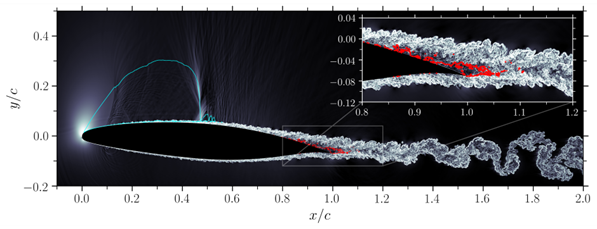
- Aerodynamic improvements. The simulations showed how active flow control can move the shock towards the trailing edge, delay flow separation and improve aerodynamic efficiency.
- Promising net energy savings. At equal lift and including the theoretical actuation cost, the aerodynamic gains can be retained after the energy used for control is taken into account.
The energy estimates assume ideal actuators without mechanical losses. They should therefore be interpreted as theoretical upper bounds, not as demonstrated reductions in aircraft fuel consumption.
Together, the results provide benchmark data for turbulent transonic flow, quantitative targets for future control studies and a portable workflow that reduces dependence on a single hardware vendor.
Potential EXCELLERAT Services:
This success story shows how EXCELLERAT can support users through concrete services for large-scale engineering simulations:
- Exascale readiness assessment for engineering codes. EXCELLERAT can analyse whether a CFD or flow solver is ready for current and future CPU/GPU-based supercomputers and identify the main technical bottlenecks.
- GPU portability and code adaptation support. EXCELLERAT can support code teams in preparing their software for different accelerator architectures, including NVIDIA, AMD and Intel GPUs.
- Scalability benchmarking service. EXCELLERAT can help users test their application on different HPC systems, measure scaling behaviour and identify how efficiently the code uses large numbers of nodes or accelerators.
- Large-scale simulation workflow optimization. EXCELLERAT can support users in optimising the full workflow, including mesh generation, solver execution, checkpointing, runtime analysis and visualisation.
- High-fidelity simulation data exploitation support. EXCELLERAT can help researchers and industrial users extract useful knowledge from massive simulation outputs, for example for turbulence-model validation, aerodynamic optimisation or AI-assisted modelling.
These services are relevant for industrial R&D teams, scientific users, code developers, HPC centres and technology providers working with complex simulation workflows in aerospace, propulsion, turbomachinery, wind energy and other flow-related engineering domains.
unique value of each service:
- Co-design and optimisation support for exascale engineering applications. Concrete applications: aircraft wing optimisation, airfoil flow control, rotor and blade design, shock-control studies, wind turbine aerodynamics and high-speed vehicle simulations.
- Efficient implementation of exascale-ready engineering software. Concrete applications: preparing CFD solvers and engineering codes for GPU-based supercomputers, supporting portability across NVIDIA, AMD and Intel architectures, and reducing dependency on a single hardware vendor.
- Performance engineering for complete large-scale simulation workflows. Concrete applications: faster aerodynamic design studies, larger parameter studies, better use of HPC allocations, reduced time-to-solution and more reliable preparation of large industrial simulation campaigns.
- Data management, analytics and visualisation for massive simulation outputs. Concrete applications: analysing shock motion, separation zones and turbulent structures; validating turbulence models; extracting design-relevant information from massive datasets; and generating data for AI-assisted modelling or surrogate models.
These services are relevant for industrial R&D teams, SMEs, code developers, software owners, HPC centres, technology providers and research groups working on advanced simulation-driven engineering.