Success Story: High-Fidelity Aeroacoustic Prediction of Chevron Nozzle Jets – A Success in Efficiency and Accuracy

success story # highlights:

  • Keywords:
    • Automotive
    • Aerospace
    • Noise prediction
    • Simulation Workflow
    • Engineering
    • Advanced Exascale
  • Industry sector: Aeronautics, Automotive, Mechanical engineering
  • Key codes used: m-AIA

Benefits:

  • Time to solution can be reduced from days/weeks to less than a day
  • Ability to effectively utilise a complete or at least a large portion of a CPU-based HPC system
  • Applicability to other research projects involving noise prediction/reduction
  • The code enhancements achieved in EXCELLERAT P2 are essential for a constrained shape optimisation of chevron nozzles for noise reduction
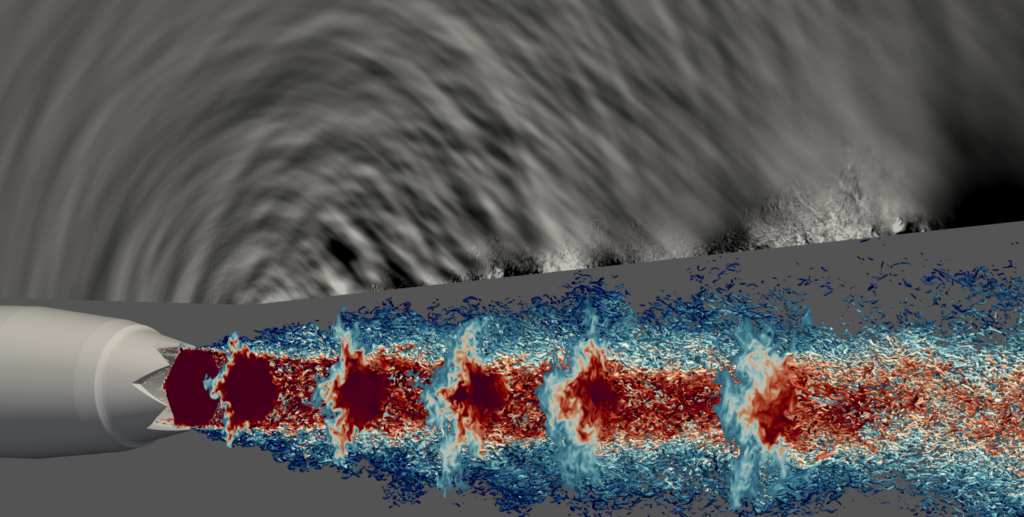
Figure 1: Aeroacoustic prediction for a jet emanating from SMC001 chevron nozzle. The visualization shows the chevron nozzle and turbulent flow structures and the instantaneous acoustic pressure field in a plane. Colors indicate the magnitude of the flow velocity and grey scales the magnitude of the acoustic pressure. (C) A. Niemöller, Institute of Aerodynamics, RWTH Aachen University

Organisation involved:

Institute of Aerodynamics, RWTH Aachen University

The Institute of Aerodynamics at RWTH Aachen University has extensive expertise in the simulation and analysis of turbulent flows and aerodynamically generated noise using high-performance computing systems. The numerical methods are implemented in the open-source multiphysics simulation framework m-AIA, developed at RWTH Aachen University. The framework is based on hierarchical Cartesian meshes and provides a range of solution algorithms covering a broad spectrum of engineering applications.

codes involved:

m-AIA

Institute of Aerodynamics, RWTH Aachen University (2024a). m-AIA. Zenodo. doi: 10.5281/zenodo.13350586

technical / scientific challenge:

Large-scale multiphysics simulations can deliver highly accurate results, yet maintaining good efficiency becomes increasingly challenging when a substantial fraction of a modern HPC system is used. For example, a coupled computational fluid dynamics (CFD)–computational aeroacoustics (CAA) simulation predicting the sound field of a high-Reynolds-number turbulent air jet emanating from a chevron nozzle showed poor scalability and low performance when scaled to several thousand nodes on the Hawk HPC system at HLRS in Stuttgart. The domain was discretised with a fine mesh comprising 3.7 billion cells in the CFD region and 4.9 billion degrees of freedom in the CAA region. These inefficiencies were not visible in reduced-size cases or on smaller systems; they only became apparent once the application was executed on O(105) compute cores. Detecting and remedying such bottlenecks at extreme scale requires specialised expertise in parallel performance engineering. Consequently, unlocking the full potential of high-resolution simulations requires both access to a pre-exascale platform and profound knowledge of how to optimise code performance at that scale. Successfully overcoming these challenges enables predictive, high-fidelity aeroacoustic simulations that can guide the design of quieter aircraft and help manufacturers meet increasingly stringent noise-emission regulations.

Solution:

The runtime performance analysis of these large-scale simulations helped identify bottlenecks in the inter-process communication between the interleaved CFD and CAA solvers that were not visible at smaller scales. Eliminating these issues significantly improved the parallel performance of the large-scale aeroacoustic prediction workflow.

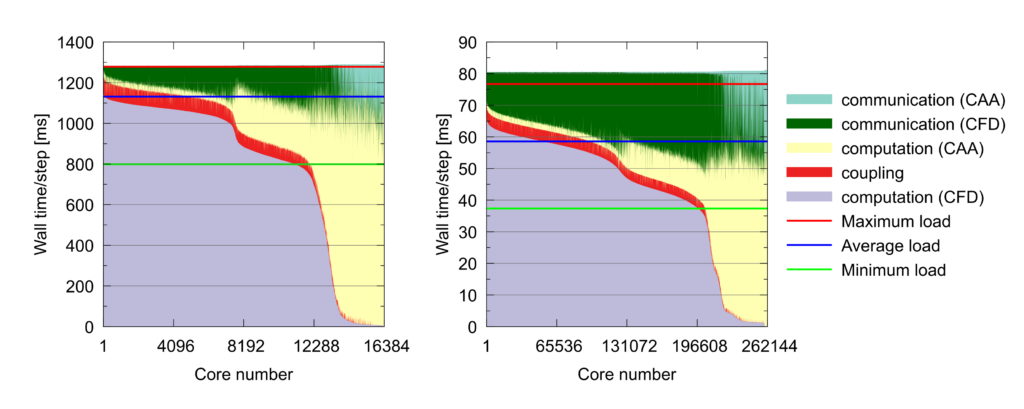
The analysis also showed that grid partitioning based on a priori estimates of the computational effort per CFD and per CAA cell introduced a substantial load imbalance (defined as the ratio of maximum to average compute load across parallel processes) of about 40%. To address this, a dynamic load-balancing approach was implemented to distribute the workload more evenly across ranks. Dynamic load balancing in this multiphysics (coupled CFD–CAA) setting is non-trivial because the CFD and CAA components rely on different numerical methods.

With these improvements, the full Hawk HPC system (4096 compute nodes) of HLRS could be utilized more efficiently. Specifically, the load imbalance was reduced to around 20%, yielding an overall runtime reduction of about 10% and enabling more effective use of the available computing resources.

Figure 2: Workload distribution of a large-scale coupled CFD-CAA simulation on 256 (left) and 4096 (right) nodes of the Hawk HPC system sorted by the computational load of the CFD solver. An increase of the nodes by a factor of 16 decreases the computational time by a factor of 15.9. While the load imbalance and communication overhead is larger on 4096 nodes, the total computing time is reduced with the local problem size and still an almost linear speedup is obtained. (C) A. Niemöller, Institute of Aerodynamics, RWTH Aachen University

impact:

The code enhancements implemented for the coupled CFD–CAA method within EXCELLERAT P2 have substantially increased the effectiveness of m-AIA for aeroacoustic noise prediction. In particular, dynamic load balancing and optimized communication patterns enable efficient use of entire HPC systems. As a result, the approach shows high scalability and supports demanding large-scale use cases on pre-exascale platforms.

These developments translate directly into a reduced time-to-solution. Problems that previously required days or even weeks can now be completed within hours, so engineering studies are no longer constrained by long simulation runtimes. High-fidelity aeroacoustic predictions on highly resolved grids—needed to reach a high level of accuracy—can be delivered in less than one day on present HPC systems, enabling faster design iterations and lowering computational cost per study.

For a representative large-scale case (3.7 billion CFD cells and 4.9 billion CAA degrees of freedom), the full simulation pipeline finishes in under a day, including sufficient physical time to compute mean turbulent flow quantities and acoustic power spectra. Compared to a baseline on 256 compute nodes, the coupled simulation achieves near-linear scaling, reaching a speedup of 15.9 on 4096 nodes. This capability supports industrial development of quieter products, with clear economic and societal benefits.

Potential EXCELLERAT Services:

  • Unique expertise in efficient coupling of CFD-CAA solvers requiring extensive data exchange on HPC systems.
  • Application of the m-AIA code to noise prediction and mitigation assessement for engineering problems on HPC systems.

unique value of each service:

  • Automatic workflow for a coupled CFD-CAA simulation to obtain highly accurate predictions of the acoustic field.
  • Shape optimisation of technical devices becomes feasible using the developed workflow in an optimisation framework.